
Following my first tutorial with my supervisor, I received some feedback that is particularly crucial at this stage. Over the past few days, I have shifted my approach; I believe I should stop trying to explain the title ‘things that made we’ itself and instead start producing some material.
Again, whilst this is a matter that leans towards personal sentiment, I shall not delve too deeply into personal stuffs; instead, I shall try to consider the issue from different perspectives. The sentiment I have repeatedly expressed—that ‘I know full well that people cannot be categorised, yet I categorise them anyway’—is, I believe, one of the most thought-provoking aspects of this project. This is because categorisation often represents more than just the behind-the-scenes work of organising material; the act of doing so can, in itself, be a form of practice. I establish a taxonomy, only to repeatedly discover its shortcomings; a single item may belong to multiple categories; there are things I simply do not know where to place; and the same item may be reclassified by me after some time has passed. The more a classification system strives to explain a person clearly, the more its failure serves to prove my original proposition.
As for the process of categorisation, I’ve discussed this with my supervisor before, and I’ve also seen a lot of relevant work by other artists—I think one thing I need to avoid is making it too neat and orderly. I won’t be using a folder system like the one I’ve used to organise my work over the past few years—such as Y1, Y2, Y3/projects—which resembles a data repository. I’d much rather keep it chaotic, whilst still being able to find some clues within it. Consequently, this is more like a multi-axial, overlapping and contradictory tagging system.
At first glance, this system seems rather complex, but I’ve found that solving this problem is actually quite simple. All it takes is a slight shift in perspective—when I select a tangible or intangible entity as the object to be categorised, rather than asking ‘what is it?’, I ask ‘what does it do for me?’. For example, a train ticket from Glasgow to Edinburgh would typically be categorised as #Object #Ticket #Travel. But such a categorisation is of no significance whatsoever to my project itself. I mean, its tags could be far more nuanced: they could be #leftBehind, #stillMissIt, #someoneElseWasThere, #barelyRemember, or even #proofThatItHappened. At this point, the ticket has transformed from a simple, individual object into a part of my personal network of relationships.
Therefore, with regard to these tags, I will first create six overlapping ‘entry points’. Each item to be categorised can belong to several different entry points at the same time.
1. WHAT REMAINS
What is it that still remains with me now?

#thingsIStillOwn
#thingsIStillRemember
#habitsIGotFromSomeone
#wordsIStillUse
#songsThatRemained
#placesICanStillPicture
#thingsWhoseOriginIHaveForgotten

Key words: cause disappeared / trace remained
2. WHAT I LEFT BEHIND
It sounds like a question: when we talk about something from the past, was it that which left me, or was it I who left it? This question appears to be quite open-ended, but it is actually rather vague and, at times, impossible to answer.
#peopleIStoppedSpeakingTo
#placesINeverReturnedTo
#objectsIThrewAway
#thingsIStoppedBelieving
#thingsIStoppedLiking
#waysIUsedToSpeak
#versionsOfMyselfIAbandoned
Key words: left me / left by me3. ONLY WITH YOU
This question came to mind when I was previously reflecting on emotions and relationships—namely, the version of myself that exists only when I am with a particular person. I think it is important to include it here, as it goes beyond simply discussing romance.
For example:
I’m only particularly loud when I’m with someone.
I would never mention certain things in front of my parents.
When I speak to someone, I use a tone of voice that I no longer use.
The person who knows me is someone who no longer exists.
What’s even more interesting is that, through this question, I can gather others’ memories of me. Perhaps there’ll be someone I haven’t seen for years, or perhaps someone I see every day, and I’ll ask them:
What sort of person do you remember me as?
I might get different answers – what do they have in common with the person I am today?
Key words: Take on others / Relationships / Changes4. I REMEMBER / I THINK I REMEMBER
As for this tag, it’s because I’d rather focus on the ‘unreliability’ of memory itself.
#IRememberClearly
#IThinkThisHappened
#someoneToldMeThis
#photographicEvidence
#rememberedDifferentlyBySomeoneElse
#IDontRememberButApparentlyIWasThere
I seek out and select these memories, and then ask the people connected to them about them. I may receive answers that are completely at odds with my own perspective. But I won’t correct them; I’ll keep both of these different versions. Because I want to get one thing straight:If a false memory shaped me, does its factual inaccuracy make its influence less real?
Key words: Truths / Self-reconciliation / Possibly-invented 5. BOTH ARE TRUE
This theme echoes what I said earlier: ‘As subjects, we contain conflicting truths.’ Here, I will focus specifically on collecting those things that exist in pairs.
I miss it.
I don't want to return.
I loved him.
I don't want to see him again.
I hated living there.
It feels like home.
I am glad it happened.
I wish it had never happened.
I don't recognise him.
He is me.
I forgot it.
It changed me.
Just like a type of collection method, or a formula:
_______, but that doesn't stop me from ________.
I can even go beyond my own perspective when gathering this material; I can obtain these contradictions from different people. The process can remain entirely anonymous, but this does not prevent me from ultimately collecting a wealth of conflicting human experiences.
Key words: Experiences / Contradictions6. UNCLASSIFIABLE
I believe there absolutely must be a category for ‘Uncategorised’. In fact, I think it should be the largest category of all. I’d throw anything into it—things I’ve kept for no apparent reason, things I don’t know why they’re important, or things that just pop into my mind. It could be a meaningless photograph, or something someone gave you without you knowing who it was.
Or perhaps a phrase that suddenly springs to mind.
When faced with these things, I find myself thinking:
“I don't know why this is here.”
I believe that if my taxonomy ultimately manages to organise everything so neatly, it would actually be a sign that it has failed.If the six points above are the broader conceptual entry points, then what I’m going to do next is add a second layer of ‘states’ to everything.
#mine #not-mine-anymore #ours #forgotten #misremembered #still-hurts #doesnt-hurt-anymore #missed #not-missed #embarrassing #precious #meaningless #used-to-matter #wish-I-forgot #wish-I-remembered #someone-else-remembers #changed-me #I-changed-it #I-dont-know-why #contradiction #evidence #no-evidenceThese tags are independent of one another and distinct from the broader sections above. They are all highly subjective and may contain contradictions, but that is precisely what I need; I want those contradictions to exist.
Returning to the earlier section on research, my supervisor and I repeatedly mentioned Pessoa and his works during our conversations. Whilst considering how best to incorporate him into my methodology, I had initially thought of directly drawing on his use of heteronyms to create distinct personalities. However, I subsequently decided it would be better not to do so. If I were to create ‘Personality A / Personality B / Personality C’, the entire project would simply revert to categorising different selves. What I can truly draw upon, however, is his shift in narrative authority.
For example, I could have different ‘versions of myself’ describe the same thing. Depending on the perspective—first person, second person or third person—the results would be very different. In my own experiments, I have found that third-person narration in particular can create a distinct atmosphere. When I wrote down something like:
He was seventeen. He believed…
My narrative perspective suddenly shifted from a personal monologue to that of an observer looking at a stranger who is connected to me, yet is no longer me. It is just as I mentioned earlier: I may not necessarily find anything in common with the person I was two years ago. When recounting the same event from different perspectives, different narrators may emerge, and they may even contradict one another. I do not intend to decide which one is ‘real’; all I wish to do is preserve it all.
Finally, I’d like to add a few supplementary points here regarding the research I’ve carried out. I’m trying my best not to fall back into the trap of doing too much research, as this tends to lead me down a dead end. However, whilst I’ve seen many works in my previous research, they’ve never actually helped me resolve one particular issue: my archive doesn’t actually need to look like an archive. What I need is an arrangement that is as chaotic as possible, yet one within which I can still find clues. I tried searching using keywords such as ‘proximity’, ‘repetition’, ‘similarity’, ‘contradiction’ and ‘association’, and came across some very interesting things.
Aby Warburg’s Bilderatlas Mnemosyne was the last of his grand, unfinished scholarly works and is regarded as a seminal work in modern art history, iconography and visual studies. This unfinished work sought to map the emotionally charged connections between art history and cosmology. Warburg believed that this visual, metaphorical encyclopaedia, through its constellations of symbolic images, could stimulate the viewer’s memory, imagination and understanding of what he termed ‘the posterity of antiquity’.
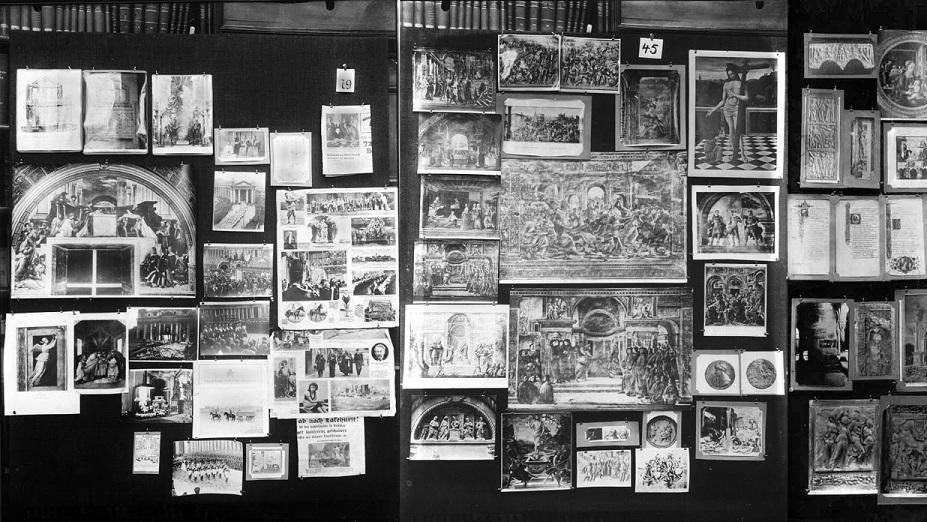
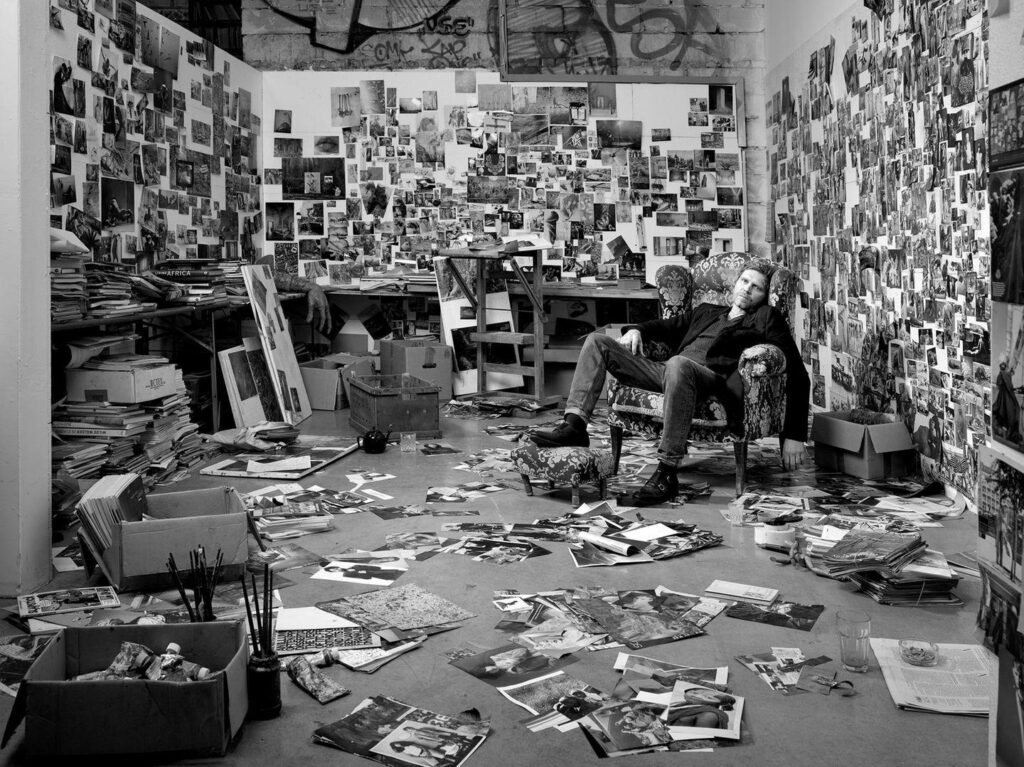
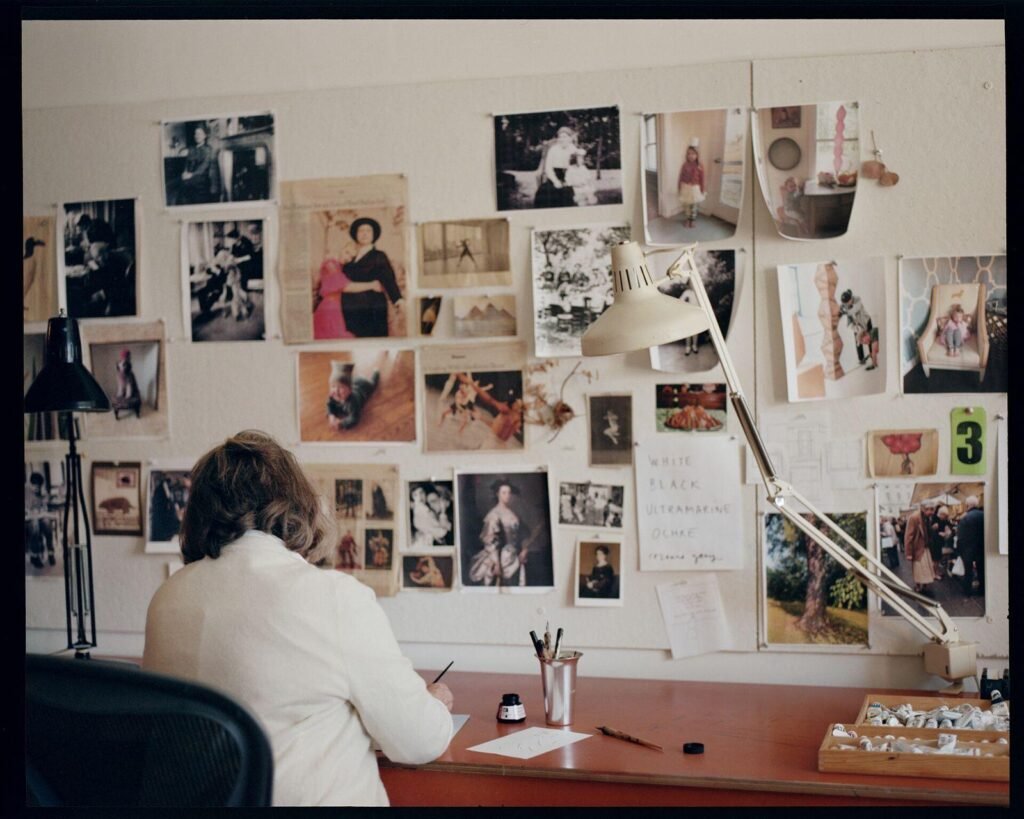
He placed a large number of images on black panels, establishing relationships through juxtaposition, without requiring the viewer to interpret them according to a linear taxonomy. This is very close to the feeling I’m aiming for at the moment.
He placed a large number of images on black panels, establishing relationships through juxtaposition, without requiring the viewer to interpret them according to a linear taxonomy. This is very close to the feeling I’m aiming for right now. I could easily cover an entire wall with my own work for the time being. Photographs, text, receipts, screenshots, maps, a quote from someone else, a QR code for an audio recording, a tag, a third-person description, and so on. And rather than categorising them according to fixed categories, I would arrange them based on the closeness of their relationships; if A and B are closely related, I would place them together. Because I am not seeking to build an archive for myself, but rather a collection of things that may have shaped me.
All in all, what I need to do at this stage is still to gather material—to collect a variety of things. I’ll be experimenting a little, trying out different approaches and different ways of thinking. I’ll build on what I’ve got so far and continue along these lines.
Furthermore, as of the date of publication of this article, I have gradually been making room in my schedule for another project. I intend to create a simple little programme based on these existing tags—which I have organised myself—to help me conduct some straightforward interviews. This will make it easier for me to gather stories and perspectives from others.