
Continuing from where we left off. Following last week’s studio support session, I too came to realise that I shouldn’t limit myself to my own ideas alone; this project needs to be underpinned by a broader range of sources. Things have been moving rather quickly over the past few weeks, and I’ve constantly felt as though I’ve missed something—I really hate that feeling, so I’ve decided to slow down a bit.
What I want to do now is actually quite simple. I intend to go and listen to other people’s stories. There are roughly two reasons for this. Firstly, the theories and statistics I’ve previously summarised apply only to myself at a specific point in time; without broader applicability, this is merely one person getting bogged down in their own thoughts—there’s a certain idealistic folly to it. Secondly, I simply want to chat with others about life—not the sort of ‘deep talk’ that comes after a night of drinking, but rather, whilst they share their experiences, I’ll gather fragments of their ‘selves’ to help complete the narrative of the entire project.
I told them it was just a simple, little interview. It doesn’t even really count as an interview—just a casual chat. I only had one request: that they bring along a random tangible or intangible object when they came to see me, to serve as a medium for our conversation. It could be a video, a photograph, a piece of text or an audio clip—something that captures a moment in their lives. It doesn’t need to be particularly meaningful; it could even be something completely meaningless. It just needs to represent a trace left by a particular moment in their lives. I don’t need them to communicate with me in any particularly formal way; they just need to come and see me when they’re ready.
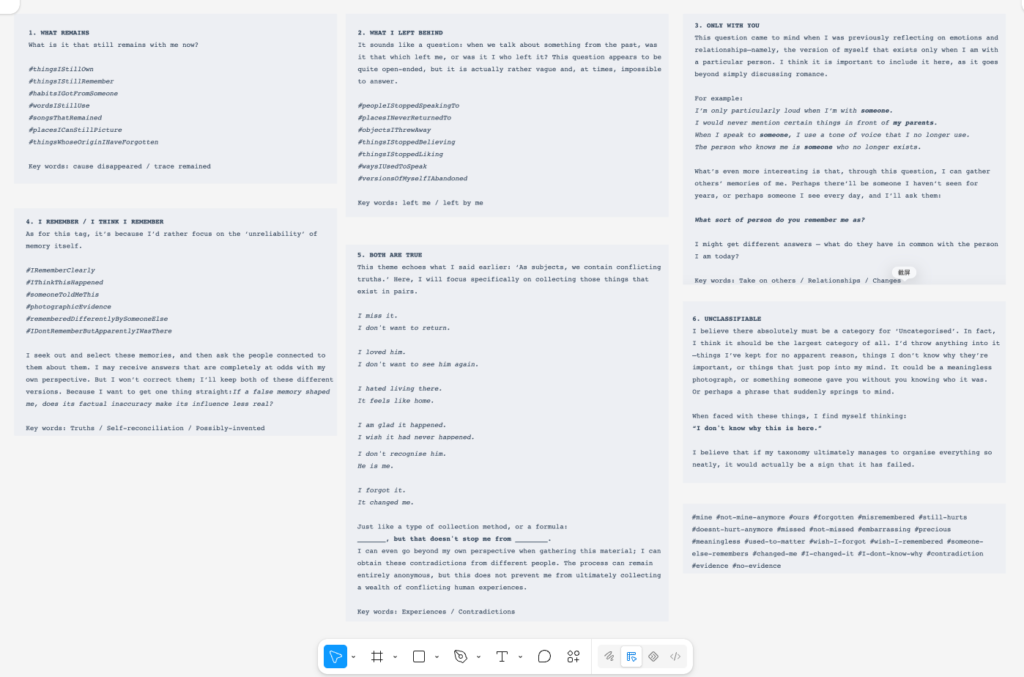
After finishing my conversation with the first interviewee, I realised there were a few procedural issues that needed addressing. Essentially, what I did was invite them to sit down at the table with me, show them some categories I’d organised beforehand, and then, using the materials the interviewee had brought along, we went through these categories step by step whilst I asked questions as we chatted. I’m not suggesting this approach is too laid-back or inefficient—in fact, I don’t really care about either of those things. I simply feel that these categories and their associated tags are very ‘personal’ in nature. People need time to reflect on their meaning and interconnections, and to select relevant tags; I cannot simply present them all at once, as that would result in many interesting aspects being overlooked. Similarly, as I mentioned earlier, these tags are highly subjective and may even contain contradictions, but that is precisely what I am looking for; I want those contradictions to exist. Tags not only help me to better understand the significance of this material to the interviewees, but also give me the opportunity to delve deeper into a particular topic and explore events that have happened to us from different angles. This is exactly what I need.
So I started wondering: could I set about creating something? A tool that would simplify certain processes and help me communicate more effectively with the interviewees? To be honest, I was also keen to actually get started on something.
This idea was quickly put into practice and turned into a small programme within Processing. I spent some time conceptualising, writing and optimising this programme; I’ll explain the code later in the article. But for now, I’ll outline the overall logic and how the programme works.
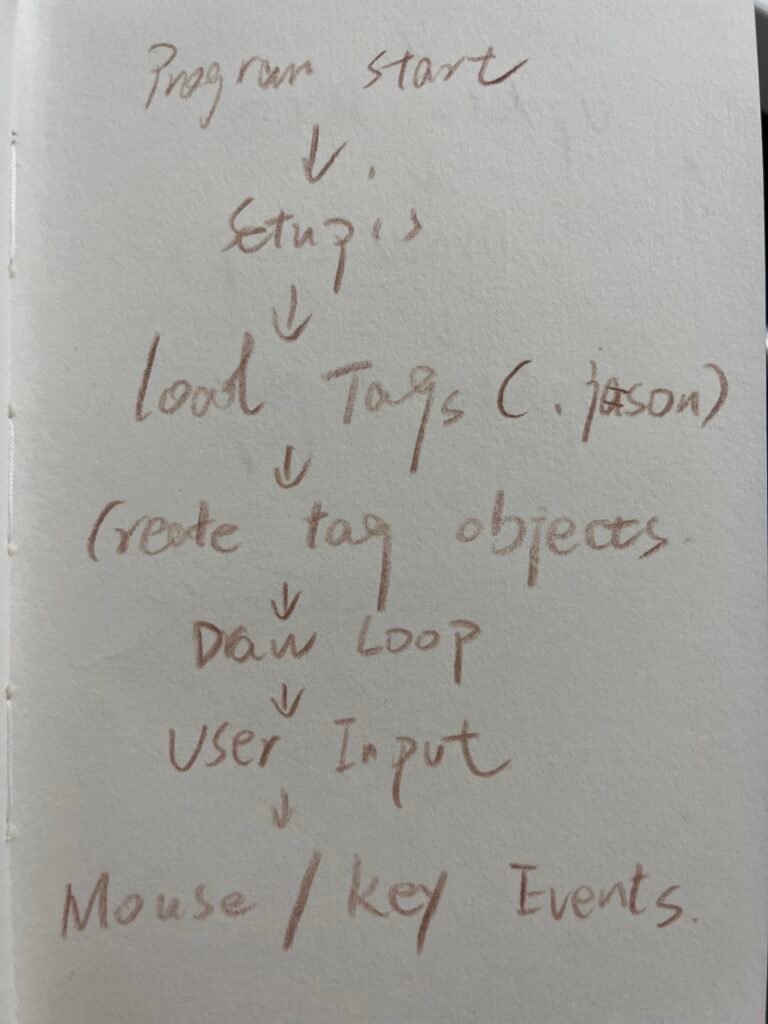
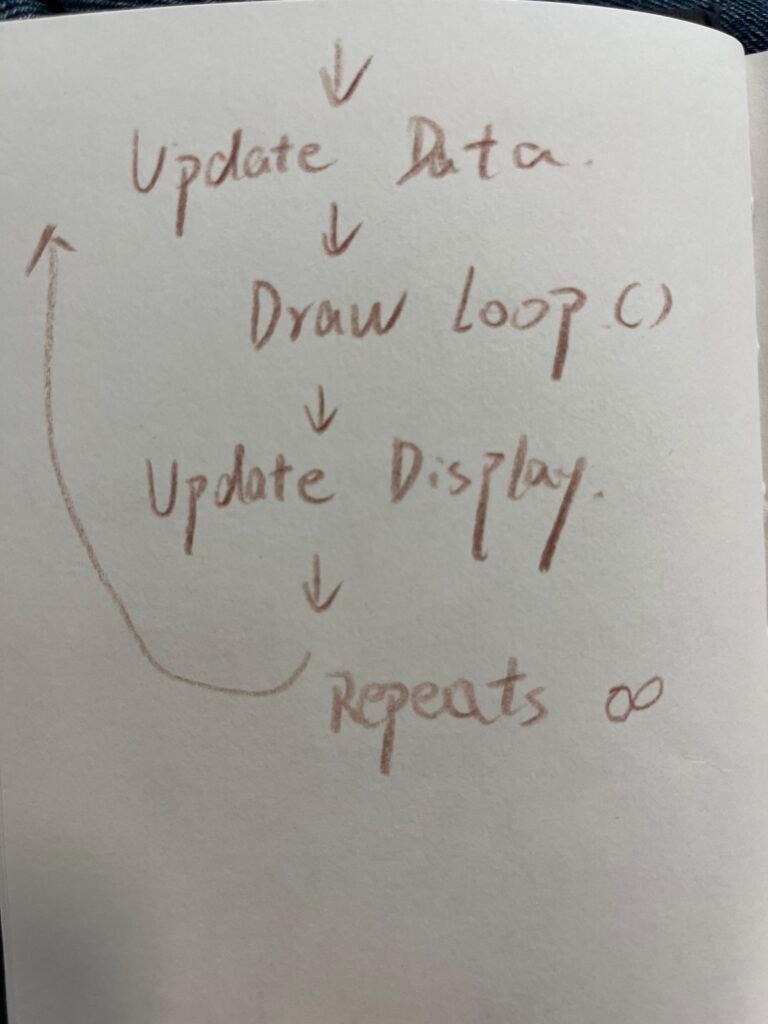
This is a rough sketch of the overall programme logic that I drew up before starting to write the code. To begin with, I divided the entire programme into three distinct systems: the data system, used to store and retrieve these tags and memories; the interface system, used to render the UI elements such as buttons, search boxes and labels; and the input and interaction system, used to read mouse and keyboard inputs whilst enabling users to search for, drag, add and delete tags. However, based on my practical testing and my expectations regarding the interview process, the programme should have a feature similar to saving the previous session. This would provide a way to revisit this material at a later date.
Whilst writing this programme, I divided it into seven sections. It serves both as a tool for organising source material and as an interactive prototype that helps participants express their memories and relationships during interviews. The overall approach is to first provide a structure that can be categorised, whilst allowing users to continually supplement or even challenge this structure through searching, customisation and the combination of seemingly contradictory elements.
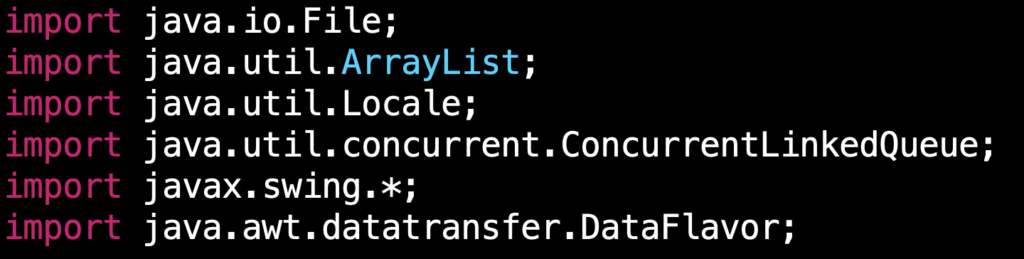
First of all, I needed to import the Java libraries. To be honest, I’d forgotten a bit about this part, so I spent some time going through the practical applications of these functions and libraries again, particularly the ArrayList. Fortunately, I found some very useful online tutorials.
Thanks Bro Code:)
Tag stores the tag name, category and associated keywords; Memory stores images or text, the creation time and any attached tags; Chip is responsible for displaying the tags on the screen and determining when they are tapped. By separating the content from the display, it is not necessary to redesign the data when modifying the interface at a later date.
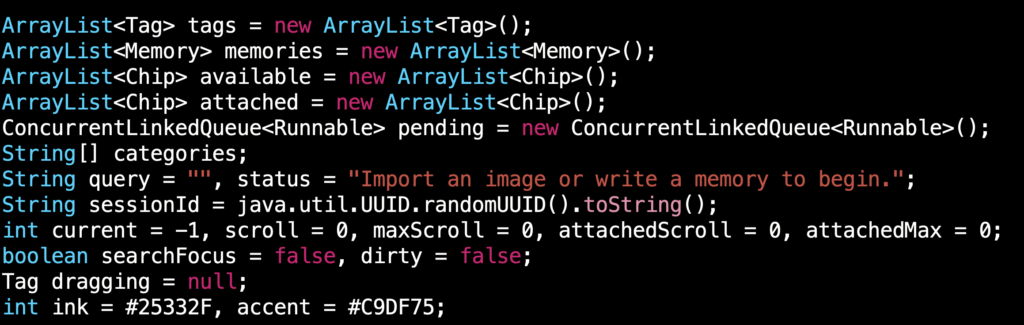
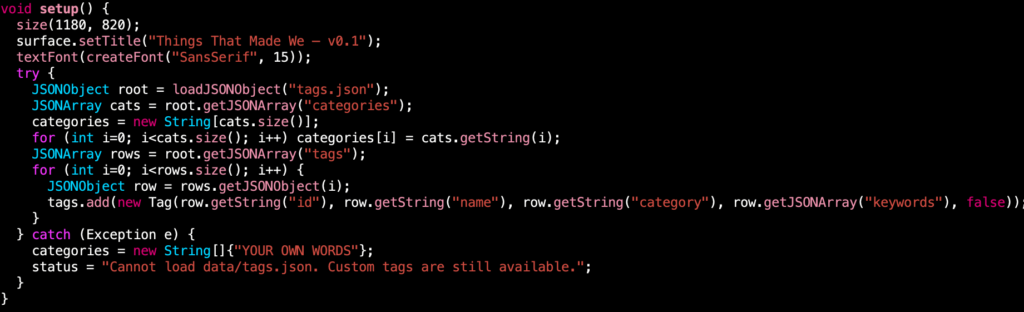
I made repeated amendments to the initialisation section. The setup() function configures the window and font, and reads the data/tags.json file. The tags are stored in a separate file to facilitate subsequent modifications to the vocabulary, without the need to amend the programme line by line. Categories have been retained as a means of navigation, but participants may combine tags across categories.
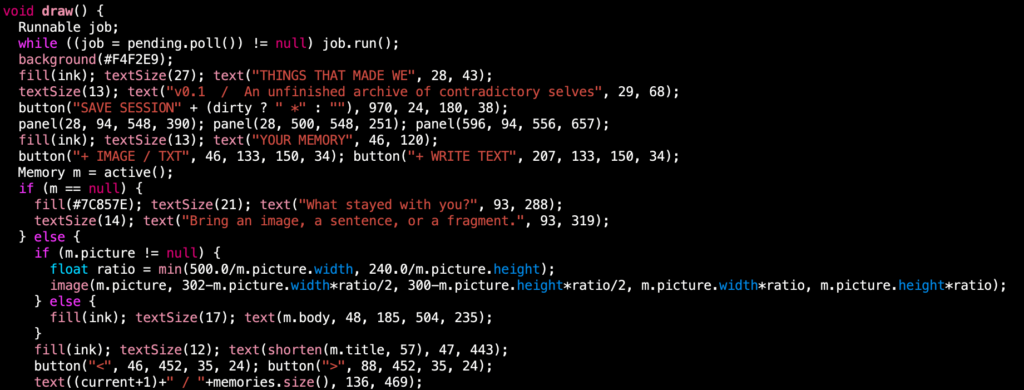
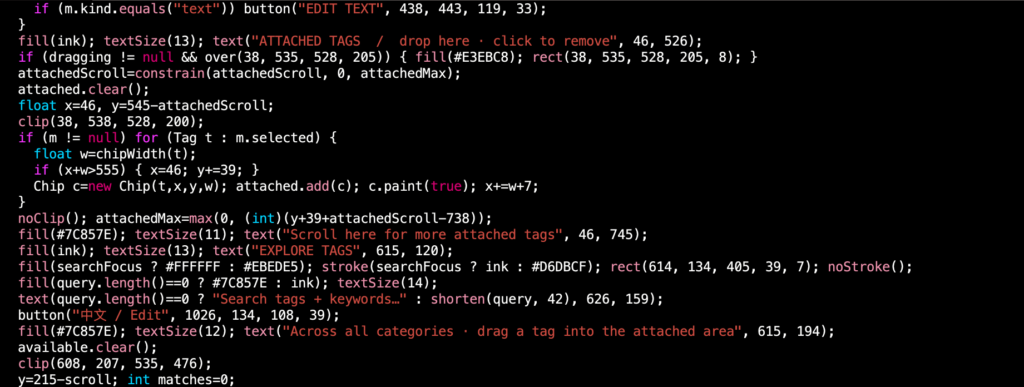
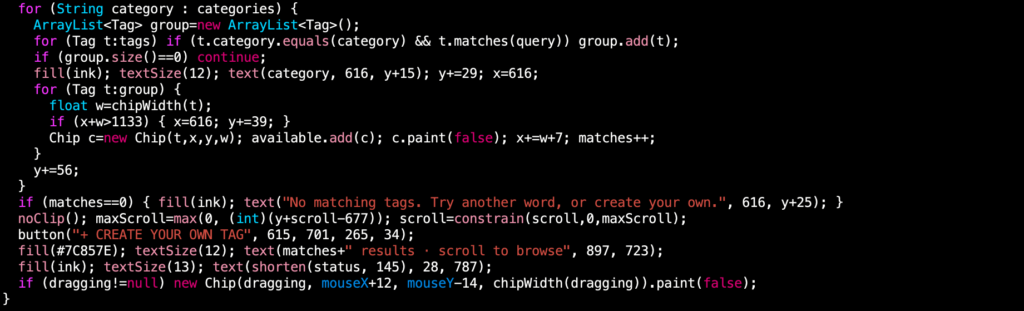
The functionality following the ‘Draw loop’ is somewhat complex, so I won’t go into it step by step here; it encompasses interface rendering, tag search functionality, and mouse drag detection. The draw() function continuously renders the media area, the ‘Tags Applied’ area and the tag browsing area. The current memory is displayed on the left, whilst tags to be selected are shown on the right, allowing the user to view the material whilst searching for words to describe it. The programme supports switching between multiple memories, making it convenient to collect several clips consecutively during a single interview. The search function checks both tag names and keywords simultaneously; it is case-insensitive for English and supports Chinese keywords. For example, entering ‘离开’ will also find relevant English tags. This way, participants do not need to understand each category heading beforehand and can search for tags using their own language. Currently, the system utilises predefined keyword matching rather than automatic semantic understanding. I have used some AI tools to optimise the interactivity in this section, making it appear more fluid. This is also the first time I have encountered this approach; my original code merely featured a mousepressed() event where clicking a tag would cause it to appear elsewhere on the canvas. Following optimisation, when the mouse button is pressed, the selected tag is recorded; as the mouse moves, a tag block follows the cursor; and upon release, the system determines whether the cursor has landed within the ‘Attached Tags’ area to decide whether to add the tag. Duplicate tags are not added again, and clicking on an attached tag removes it. The programme allows conflicting tags to coexist, as the same memory can evoke both nostalgia and sadness simultaneously.
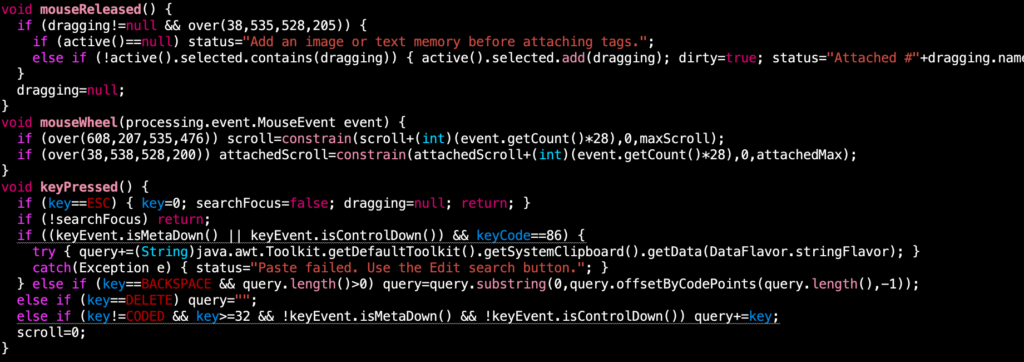
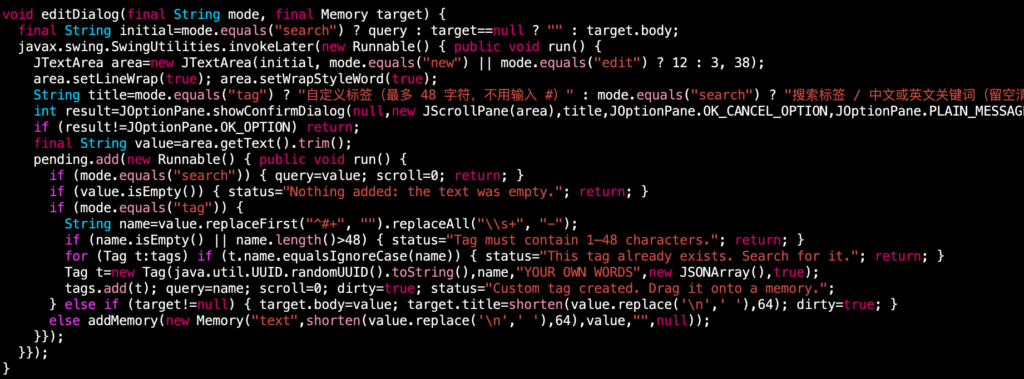
The final feature to be introduced is the ability to import materials and create custom tags. File import supports both images and text, and text can also be entered or edited directly. Custom tags allow participants to add expressions not found in the vocabulary database, thereby avoiding the need to choose solely from pre-set answers. Text editing utilises the system’s input window, primarily to ensure reliable support for Chinese input methods and long texts. To be honest, I didn’t really feel compelled to add Chinese language support to this programme, but I included it for the sake of its universal applicability – after all, who knows whether I might end up interviewing other people?
Oh, and there’s also a tag-saving feature—I’ve mentioned this before, so I won’t go into detail here. Essentially, saveSession() writes all memories, selected tags and custom tags from the current session to a JSON file, generating a new file each time. Text is saved in full, whilst images are recorded with their original file paths. This structure makes it easy to compare the choices of different participants later on, or to use the data for visual design; however, it is not yet possible to reopen old sessions within the programme. This is my issue; I don’t have much time at the moment to continue optimising it. My plan is to complete all the interviews by next week, and this minor bug won’t affect the programme’s functionality. I’ll just leave it as it is for now. In summary:
The final interface looks like this
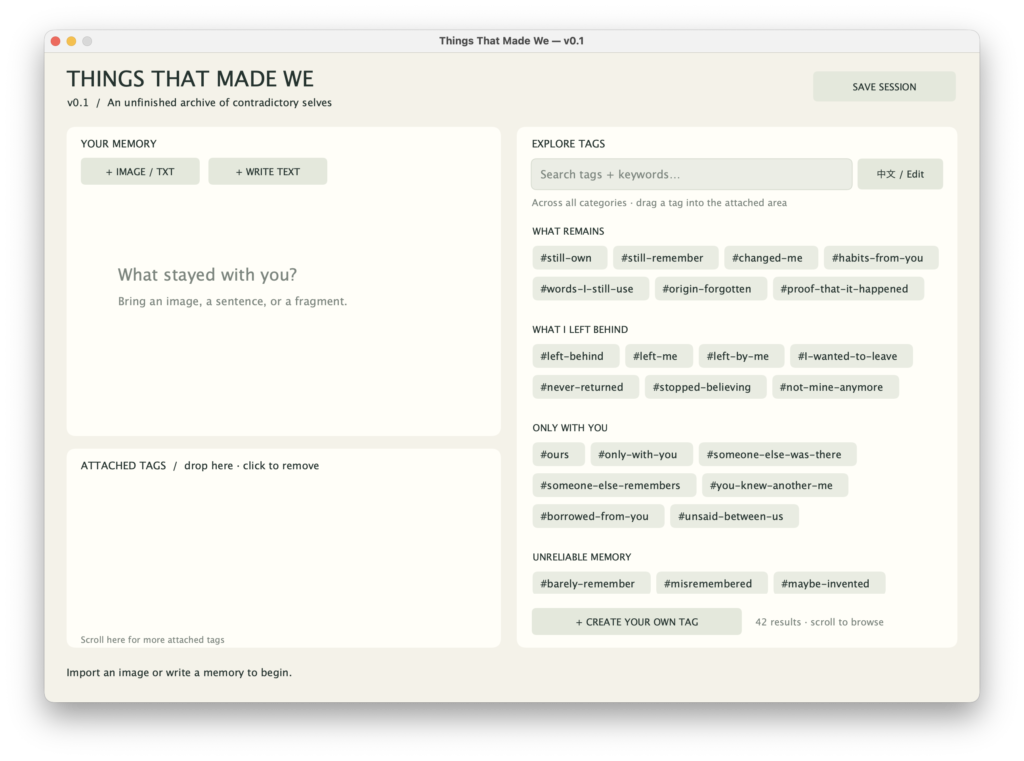
This programme includes all the features I had envisaged, and I use it during my interviews. Interviewees can import text or media into the top-left corner, then select relevant tags from the right-hand side and drag them into the box in the bottom-left corner. They can also create their own tags and carry out searches. Finally, by clicking ‘Save Session’, they can export the interview as a result, saving it as a .json file.
I have collected numerous stories from various people, along with the media they have provided as reference material. Most of these are photographs, which is fascinating; indeed, photographs are the medium best suited to transporting people back to a specific point in time. Below, I will present all the interview excerpts and audio recordings I have gathered during this period, though this process is ongoing.
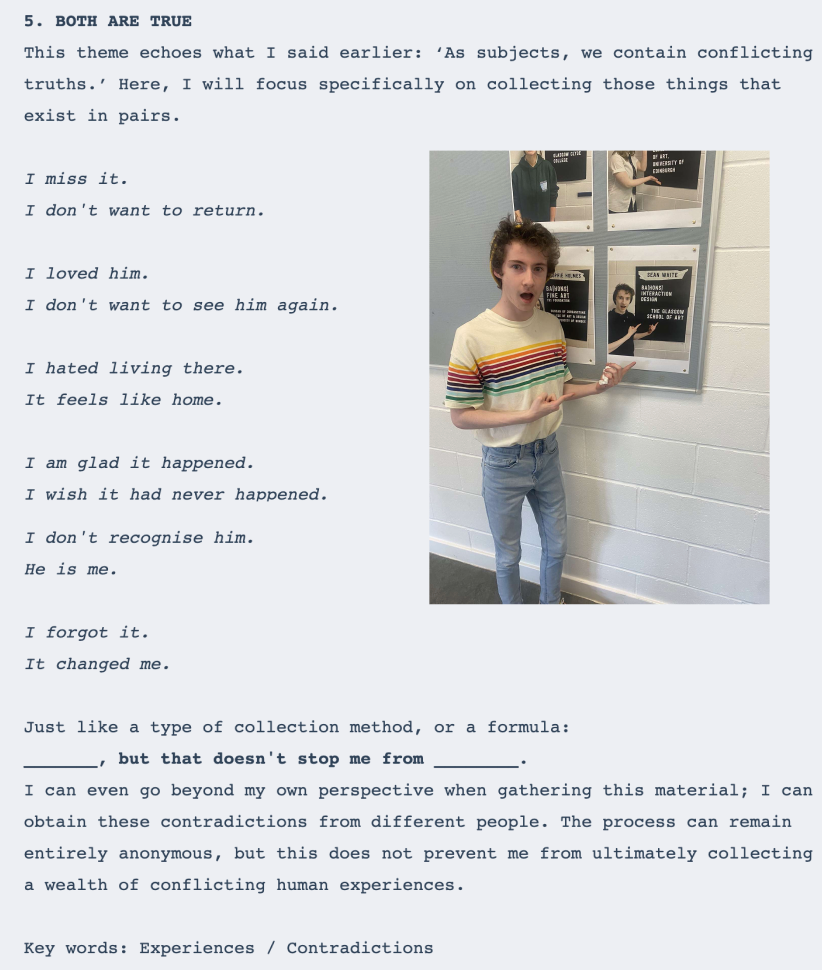
Sean Interview
Sean showed me a photograph he had taken whilst at secondary school. It was taken at the very moment he made the decision to come to the GSA—arguably one of the most important decisions of his life. I am very grateful to him for sharing such a significant moment in his life with me. I equally believe that, for most of us, the decision to come to art school is just as significant; it marks a complete shift in the course of one’s life. We discussed these broad categories one by one; although some topics weren’t particularly relevant to this photograph, as peers we shared many similar experiences and perspectives on certain matters. Interestingly, although we come from different corners of the world, some of our experiences are remarkably similar; we face the same challenges of growing up, life choices and life experiences. And it is fascinating to note that our generation has collectively lived through the same extraordinary period—the pandemic. This has had a greater or lesser impact on everyone’s life path. During this interview, I did not strictly adhere to the plan I had set out beforehand; it felt more like an informal, in-depth conversation. For me, this conversation was incredibly important; it made me realise that many of the views I wanted to express are actually shared by a great many people. Drawing on similar or different experiences and perspectives, they’ve given me plenty of new insights. Perhaps sharing the twists and turns of one’s life journey isn’t such a niche pursuit after all.
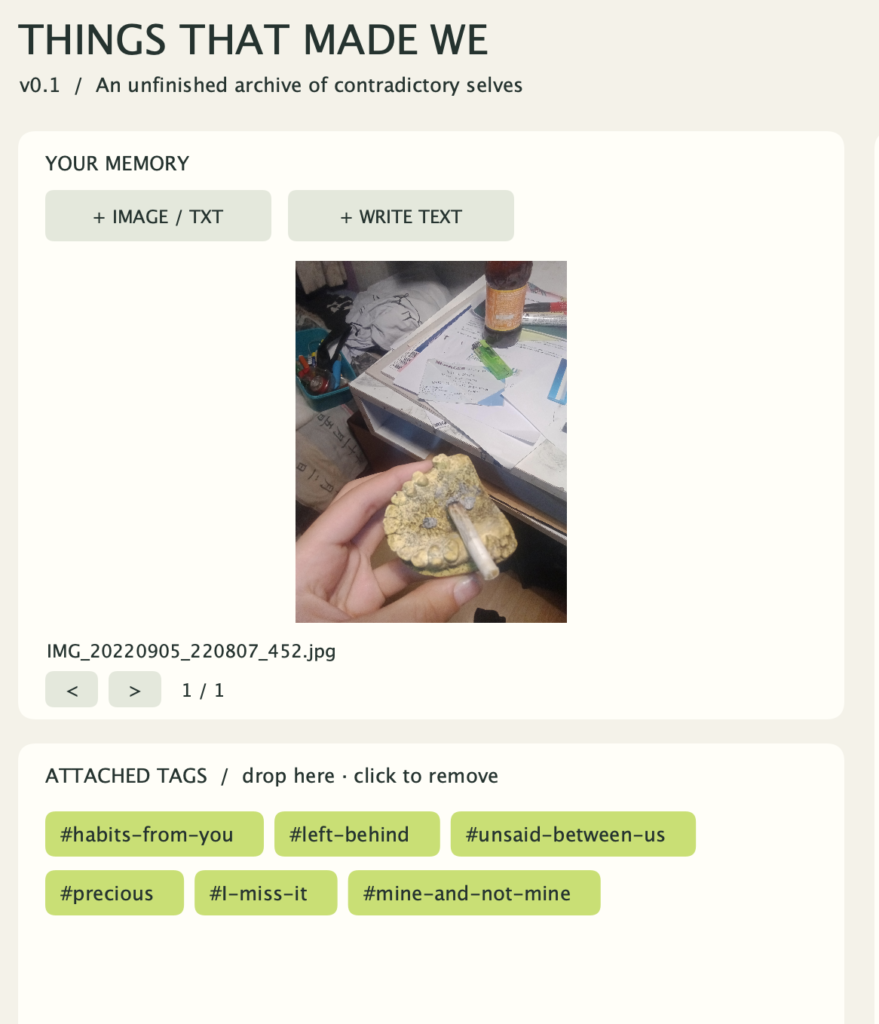
Celeste interview
Celeste showed me a photograph taken at her grandfather’s house. It was a little corner of her own, filled with items that belonged to her or represented her childhood. In the centre of the picture, she was using a model of her baby teeth as an ashtray. We talked at length about her childhood memories; an interesting fact is that, having also grown up with my grandparents, I share some of the same emotional experiences with her. Sometimes we feel the same way about life. We tend to make similar choices when it comes to family relationships, lifestyle habits and the like. Likewise, we both miss those days and the place where we lived as children, yet neither of us wants to go back. Times have changed and we’ve grown up, but certain things remain etched into our personalities or lives as a backdrop to our existence.
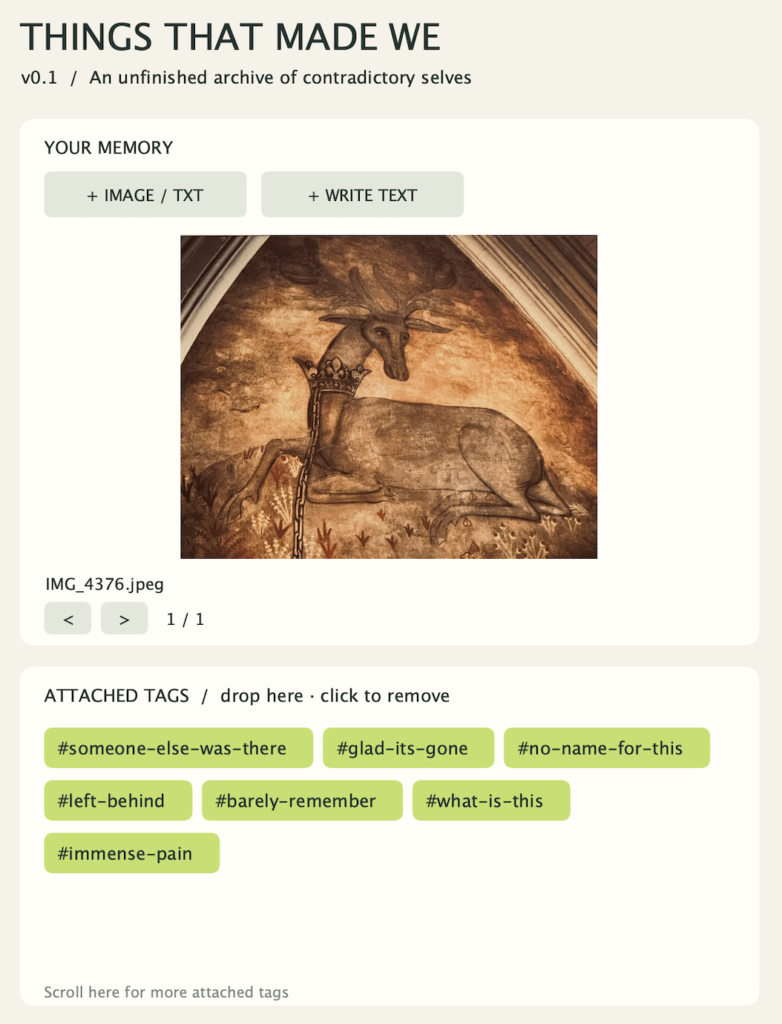
Jack Interview
During my interview with Jack, he showed me a rather interesting, even slightly amusing, picture. It was a mural he’d seen whilst visiting London with friends; it was supposed to be an animal that looked a lot like a deer, and they’d all laughed at how funny the animal in the picture looked. What struck me during our conversation was that this was, in fact, a genuine memory he shared with others. As I mentioned earlier, people have different attitudes and emotions towards the same memory. Take this deer, for example: some might find it hilarious and remember the moment of shared joy with their friends; others might not find it funny at all, but would recall the joy of their friends acting silly together; whilst still others might have no recollection of the memory whatsoever, yet this does not mean they were not actually there at the time. The reason memory is unreliable is not merely due to subjective or objective factors (though these are certainly contributing causes), but rather because it naturally manifests itself in different forms throughout our lives.
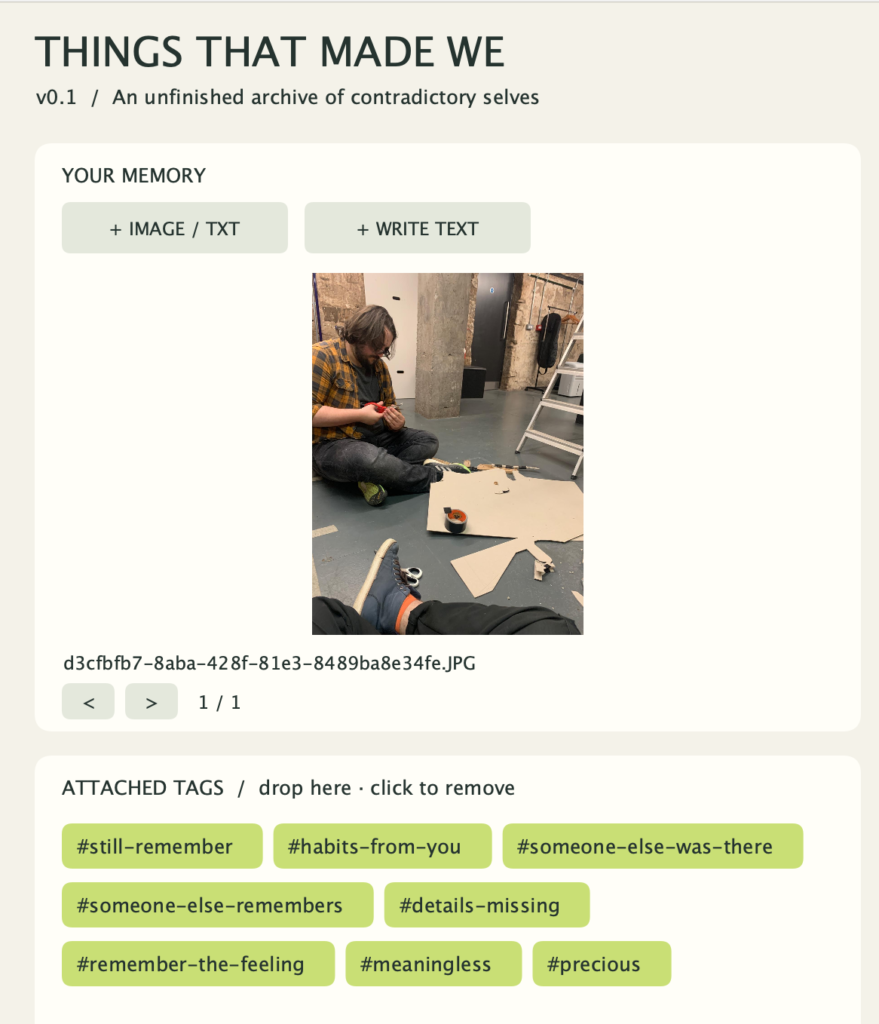
Pav Interview
Pav showed me a photo that felt more true to life: it captured him and his best friend making a toy gun out of cardboard after finishing work one Friday. From our conversation, I sensed that he truly cherished that moment; for him and his friend, it was not merely a nostalgic memory, but a breathing space that life had granted them amidst their hectic daily routines. In fact, more often than not, people do not realise what they need to feel truly alive. A life of repeating the same routine day in, day out—work, daily life, sleep—may leave some people feeling fulfilled, whilst others feel empty. I think we’ve all engaged in acts of escapism from adult life at some point, just like Pav and his friend: two men approaching thirty, one of whom even has a family, sitting together after work to make a potato gun. Perhaps he only experiences such feelings and moods when he is with his friend. In that single moment, they share a common experience and a shared emotional state.
I initially approached these interviews as a way to explore how people connect objects, memories and experiences to their sense of self. However, the conversations have often felt less like formal interviews and more like casual exchanges. People showed me photographs, objects and fragments of their lives, and we simply talked about them.
I cannot say that these conversations have led me to any major conclusions yet. But I have found the process unexpectedly meaningful. I am grateful that people were willing to share even a small part of their lives with me. I am beginning to wonder whether the value of these encounters lies not only in the materials I collect or the tags people choose, but also in the act of sharing itself. Perhaps I should pay more attention to what happens during these conversations, rather than only what can be extracted from them afterwards.
Although there are still some interviews in the pipeline, and some that I need to go through again, I don’t intend to devote all my energy to this at the moment. For me, the most important thing right now is to start creating something.
Today I received feedback on my last show-and-tell session; my tutor’s advice was in line with my own thoughts—I should start making something.
Over the past few weeks, I’ve actually gathered some material, but I haven’t yet found a way to transform it into a visual or sensory experience. So rather than waiting until I’ve found the final form for the piece, I should explore it through the process of creation.
I believe I need to try to express the traces left behind by the past, and how different versions of myself co-exist. At the same time, I do not wish to limit myself to images and digital interfaces; I can experiment with a variety of media, including sound, video and physical materials. I have also realised that I, too, am a subject that can be studied, deconstructed and reassembled. Moreover, unlike when interviewing others, I am free to use my own old photographs, recordings, writings, objects and memories, without having to constantly consider participants’ privacy or seek permission.
There is one further point that I consider quite important, a term that has been repeatedly mentioned by various tutors in both the tutorials and feedback: ‘traces’. I believe there is a fascinating distinction between ‘trace’ and ‘memory’. ‘Memory’ usually refers to things we are still able to recall. A ‘trace’, however, does not necessarily need to be remembered by us. This lends itself well to expression through material and visual experimentation, as traces do not necessarily need to be clearly recognisable.
Actually, I’ve already had a few simple ideas, inspired by something rather interesting that came back to me whilst I was sorting through my memories. There’s a gesture I used to do a lot as a child—I don’t know if children elsewhere do this, but when I was little, I often used to do this handshake gesture with other children: the two of us would hook the four fingers of our right hands together, with our thumbs pressed up as if stamping something. I suppose it served much the same purpose as hooking little fingers? I remember this move very clearly, as I’ve performed it more than once with different people. However, I’ve tried looking for some pictures or something similar, but I can’t find anything at all.
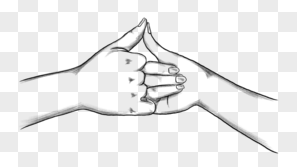
It’s something like this, I suppose
It’s a bit different from how I remember it, but I really like this sense of uncertainty. Because I still remember how to do the movement, but I don’t quite remember exactly how it was done or what it meant at the time. It’s not quite as I remember it, but I particularly like this sense of uncertainty. Because whilst I still remember how to perform this movement, I don’t entirely recall exactly how it was done or what it signified at the time. It’s almost a very concrete ‘trace’. My body still retains some remnant of that past movement, yet I can no longer fully reconstruct its context or meaning. I believe this is more meaningful than simply displaying a childhood photograph.
I began conducting some small-scale experiments based on this inspiration. I wanted to try building a small robotic arm capable of performing movements similar to those mentioned above. I actually already have a preliminary concept for the final product. It’s not something I’ve rushed into, but rather a well-thought-out idea. I believe the finished piece should be a three-in-one art installation combining touch, sight and sound. Essentially, the tactile element acts as a kind of switch, helping people to enter an emotional environment created by sight and sound.
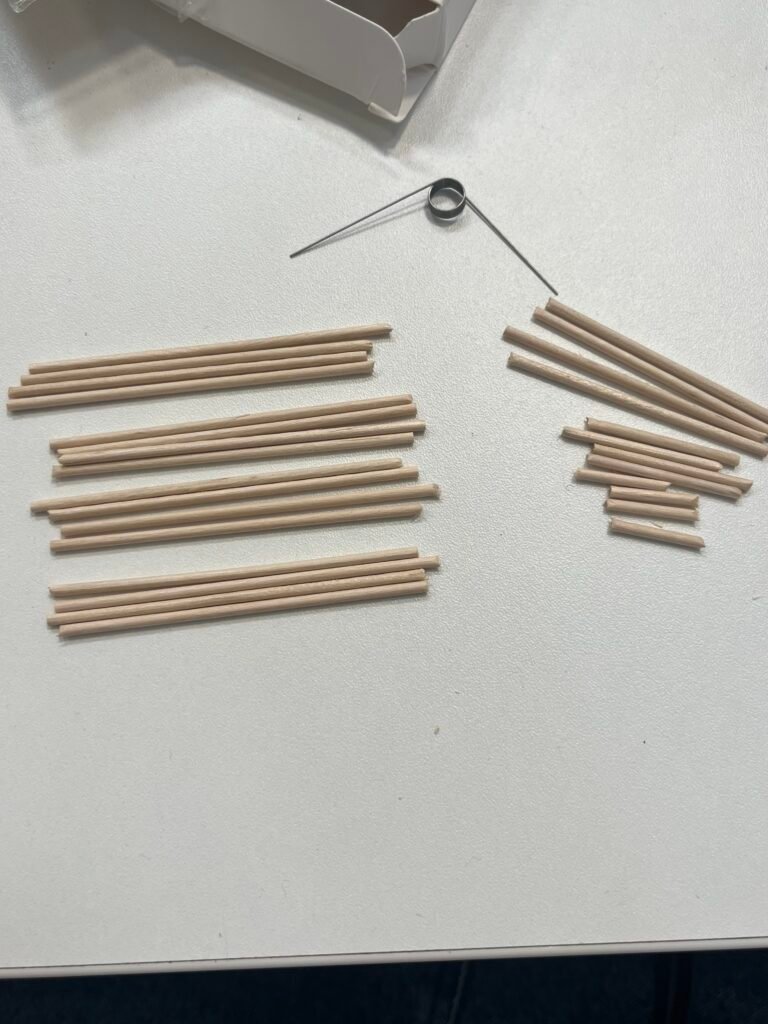
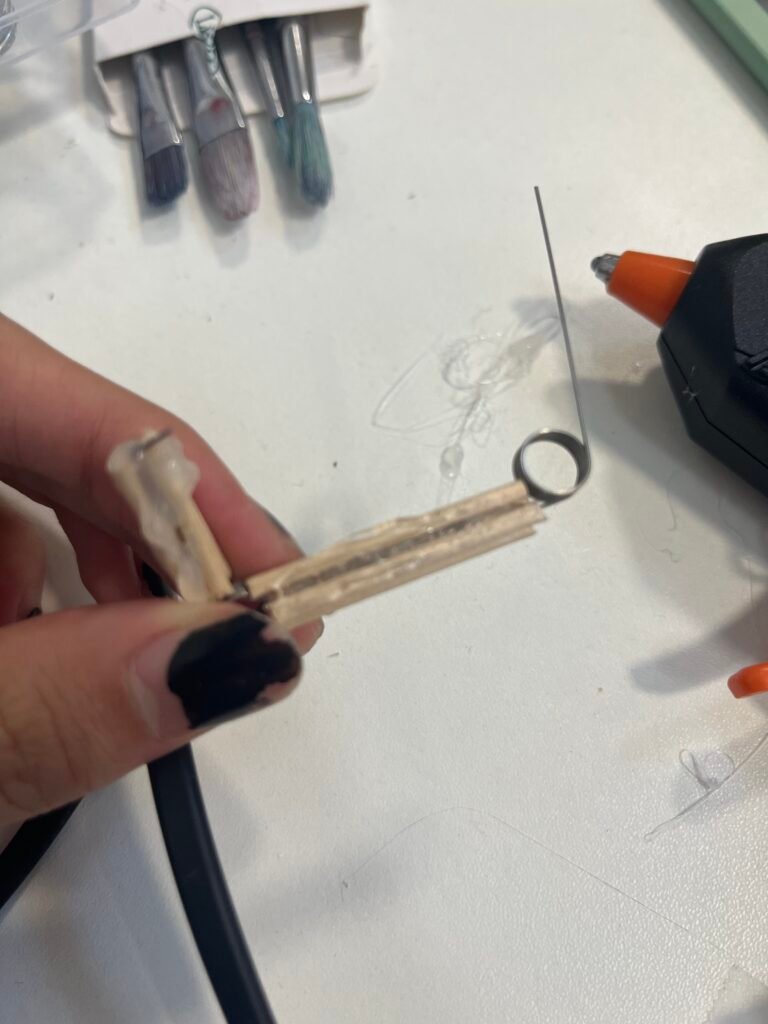
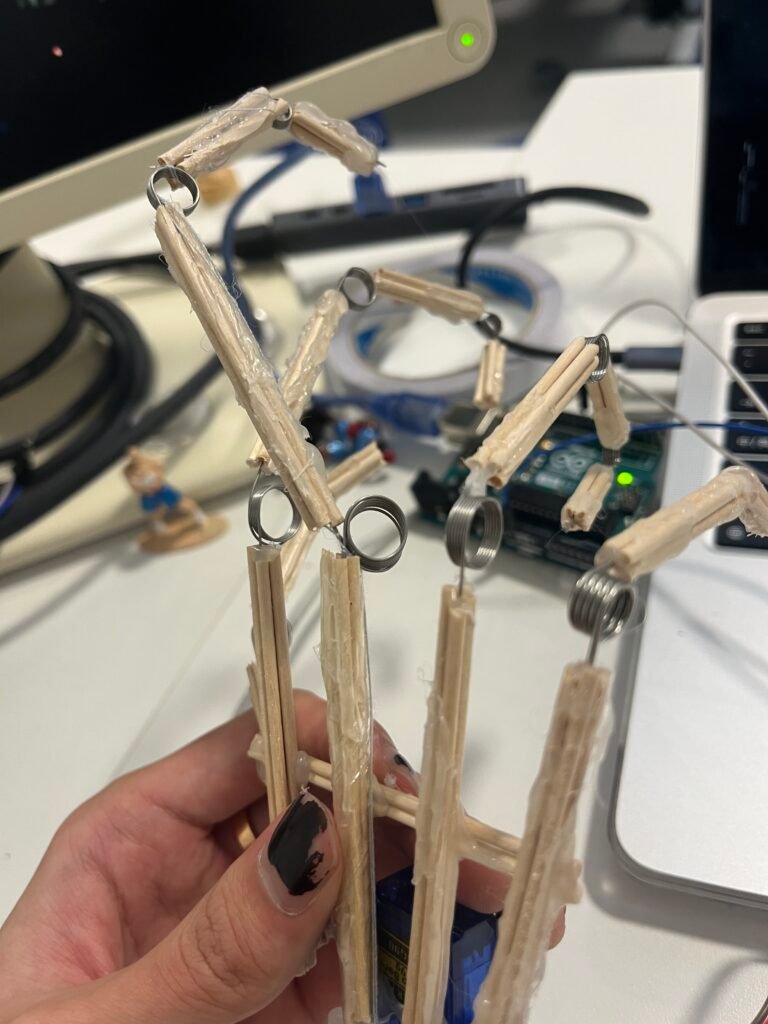
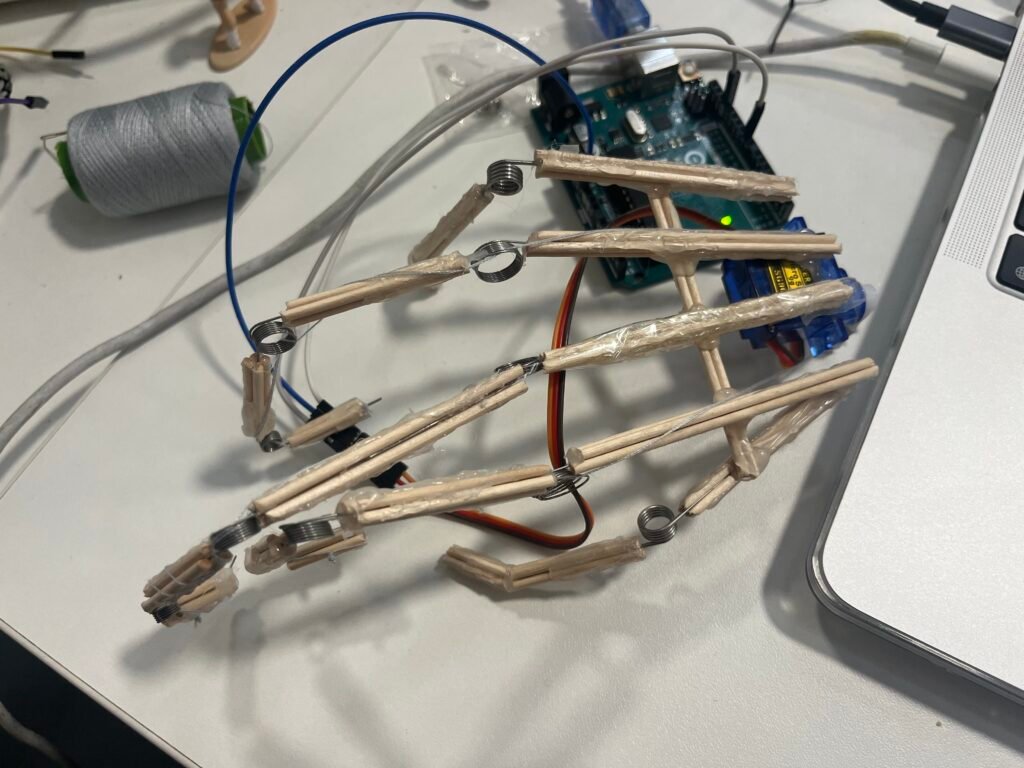
I spent some time building a very simple little prototype. Its structure is extremely straightforward: the wooden skeleton is held together with hot glue, and the joints are replaced by small springs. Thread is concealed between these bones and joints, and is pulled by a servo motor at the tail end. I also experimented with using a touch sensor to control the servo’s movements. At present, it can only perform some very simple movements. However, it at least demonstrates that this approach is viable. My vision is that it will be able to control the movement of each individual finger independently.
Some demonstration videos.
I used to rack my brains trying to work out how ‘Things That Made We’ could be visualised: superimposed photographs, sound collages, personal profiles, afterimages and so on. These are all valid approaches, but they are, to a greater or lesser extent, concept-driven, with the search for a suitable medium coming afterwards. I now realise, however, that what I actually need to do is find a language of expression that is uniquely my own. Take this little robot, for instance. I started with a specific action from my own childhood—interlocking four fingers with another child, then using our thumbs to ‘seal’ some sort of agreement, as if stamping it—which led me to the idea of creating a mechanical hand capable of responding to touch. This process quite naturally evolved into a form of interaction. It suggests that my previous understanding of my own structure was meaningful. I intend to continue exploring in this direction.
As for my plans moving forward, whilst I look for ways to optimise this ‘Little Hand’ prototype, I will also be exploring various aspects of sound. In fact, I already have a clear research path in mind. I have realised that if the final product is to be an interactive installation, sound may well be its true emotional core. I therefore intend to try combining monologues, previous interview recordings and even my own compositions to explore how these sounds might interact with one another. I shall continue to investigate this further.